Equity Theory
Equity Theory, proposed by John Stacey Adams, is a motivation theory that emphasizes fairness in the workplace and its impact on employee motivation and behaviour.
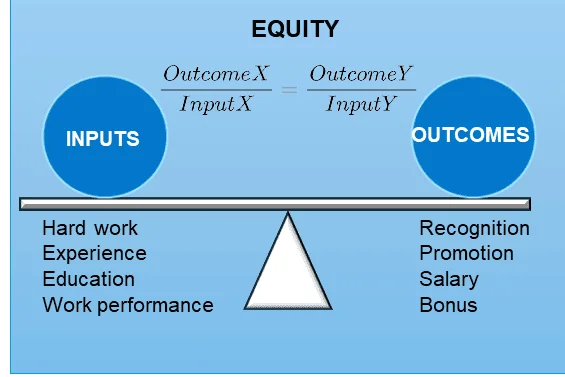
Input–Output Ratio
Inputs
These are what employees contribute to their jobs, such as:
- Effort
- Skills
- Experience
- Time
Outputs
These are the rewards employees receive, including:
- Salary
- Benefits
- Recognition
- Promotions
Employees evaluate their own input–output ratio and compare it with that of others.
Inequity in the Workplace
Two common types of inequity include:
- Underpayment Inequity:
- When employees feel they receive fewer rewards compared to others despite similar or greater inputs.
- Overpayment Inequity:
- When employees feel they receive more rewards than others for similar inputs.
Impact on Motivation
When an employee is dissatisfied with their input–output ratio compared to peers, motivation can be at risk.
Similarly, when employees perceive their reward-to-effort ratio as higher than others, it may create feelings of guilt and negatively affect motivation, as individuals naturally strive to maintain balance and fairness.