Herzberg’s Two-Factor Theory
1. Motivators (Satisfiers)
Nature:
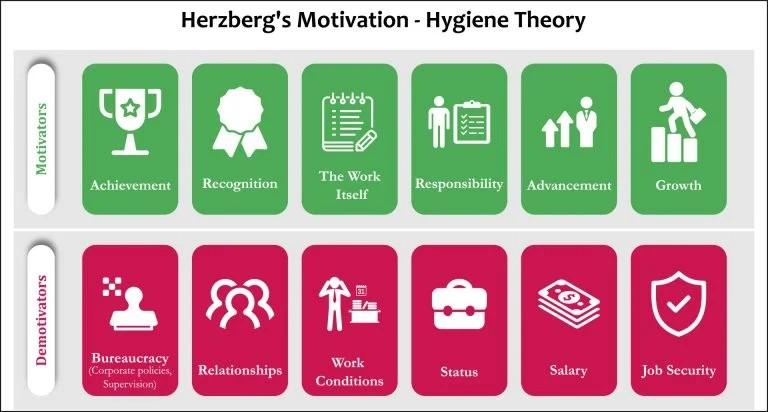
They are called motivators because they lead to job satisfaction and motivation when present (e.g., achievement, responsibility, personal growth).
- These relate to the content of the work and personal growth.
- They tap into an individual’s internal drive and desire for meaning, challenge, and achievement.
- These are intrinsic to the job itself.
- They are essential for creating job satisfaction and motivation.
Examples:
- Achievement: Feeling a sense of accomplishment from completing challenging tasks.
- Recognition: Being acknowledged and appreciated for one’s contributions.
- Advancement: Opportunities for promotion and career growth.
- The Work Itself: Finding the work interesting, challenging, and meaningful.
- Responsibility: Being given autonomy and control over one’s work.
- Personal Growth: Opportunities for learning and development.
Impact:
When motivators are present, employees feel satisfied and motivated.
The absence of motivators does not necessarily lead to dissatisfaction, but it results in a lack of satisfaction.
2. Hygiene Factors (Dissatisfiers)
Nature:
These factors prevent dissatisfaction when adequate (e.g., salary, supervision, company policies).
- They do not create satisfaction when improved; they only prevent dissatisfaction.
- These are extrinsic to the job itself.
- They relate to the context or environment in which the job is performed.
Examples:
- Company Policies and Administration: Fair and clear policies, efficient administration.
- Salary: Adequate and competitive pay.
- Interpersonal Relations: Positive relationships with colleagues and supervisors.
- Working Conditions: Safe, comfortable, and adequate work environment.
- Supervision: Competent and fair supervision.
- Job Security: Feeling secure in one’s employment.
- Status: The level of recognition and respect within the organization.
Impact:
When hygiene factors are inadequate, employees become dissatisfied.
Improving these factors reduces dissatisfaction, but it does not necessarily lead to satisfaction. It only brings employees to a neutral state of “not dissatisfied.”
Their presence keeps employees from being unhappy, but only motivators can make them truly satisfied.