McClelland’s Theory of Needs
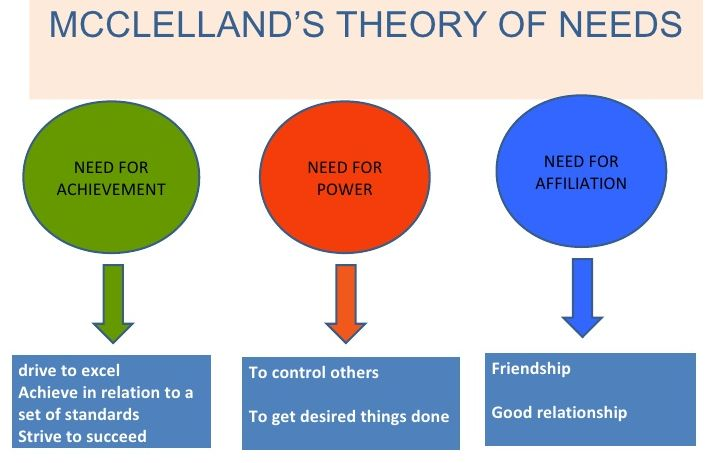
This theory suggests that people are motivated by three main needs:
1. Need for Affiliation
The need for affiliation refers to the desire to maintain positive social relationships with others.
- These are classic extroverts who love the company of others.
- Everyone has some need for affiliation, but for many people, this need is high.
- For people with a high need for affiliation, the task itself is not essential; instead, they respond to situations where people depend on them.
- For students, this can include situations such as group projects or team sports.
- Nothing can cripple highly affiliated people more than isolation.
- Students with a low need for affiliation may also face issues if they are always expected to socialise and be part of a group.
2. Need for Achievement
The need for achievement refers to how strongly a person wants to succeed at completing a task.
- High-achieving people feel a personal responsibility when they are given a task.
- They prefer projects with a moderate chance of success.
- High-achievement individuals dislike tasks that are too easy.
- They also lose motivation for tasks with a very low success rate.
- High achievers have a strong desire for feedback, as they want to know whether they have achieved success.
3. Need for Power
The need for power is the desire to control or influence other people.
McClelland identifies two types of power:
- Personal Power:
- The power to control others, often political in nature and driven by a personal or hidden agenda.
- Social Power:
- The desire to influence others in order to achieve the goals of the group or the organisation.