Variables of Vroom’s Expectancy Theory
Vroom’s Expectancy Theory
This theory explains how people are motivated based on their expectations about outcomes. It was given by Victor Vroom.
He believed that people’s motivation is influenced by the type of reward they expect to receive for performing their tasks well. People in an organisation determine how much effort they should put in to get the required rewards. Humans are rational beings, so they attempt to increase the perceived worth of rewards. People become highly motivated if they believe that behaving in a particular way will lead to preferred rewards.
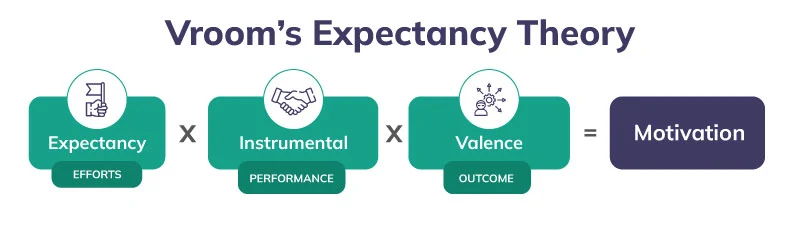
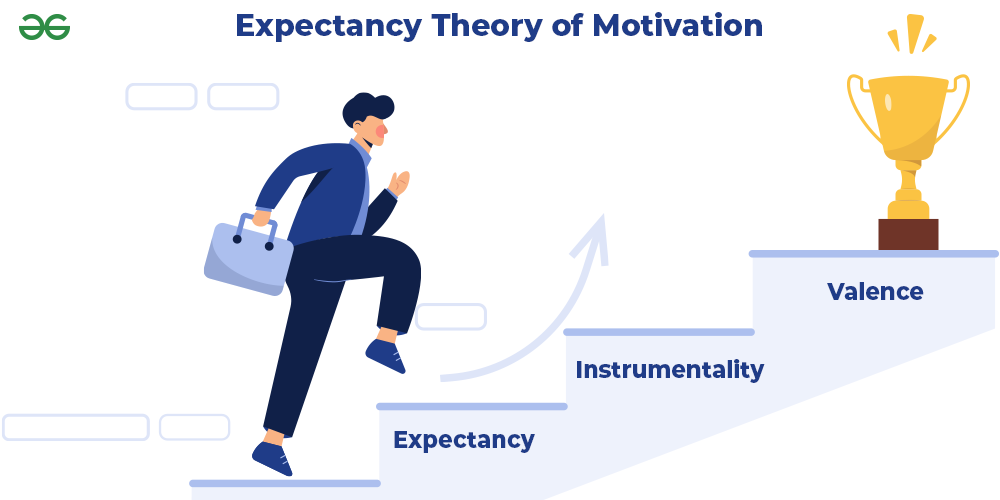
In Vroom’s model, three variables are involved:
- Valence
- Expectancy
- Instrumentality
1. Valence
- Valence refers to the value of the rewards that result from performance.
- Whenever an individual has a preference for any reward, valence indicates the value of that preference.
- Every person has a different perception of valence.
- What is valuable for one person may not be valuable for another.
- For example, employees interested in promotion and recognition may not value cash rewards.
- Valence is the attraction or repulsion of an outcome.
- Valence is not the actual value of the reward, but the perceived value of the reward expected after attaining goals.
- Valence can be zero when employees are indifferent about outcomes.
- Valence can also be defined as how much an individual really wants a reward.
2. Expectancy
- Expectancy indicates the extent to which a person believes that effort will result in the first-level outcome, such as task completion.
- Expectancy is the likelihood that a specific action will result in a specific outcome.
- It is the individual’s perception of the probability that a particular behaviour will lead to a certain outcome.
- It is also referred to as Effort–Performance Probability.
- It explains the relationship between effort and performance.
- The value ranges from 0 to 1.
- If employees feel the likelihood of attaining an outcome is 0, effort will also be 0.
- If employees feel the likelihood is 1, they will put in more effort.
- Expectancy can be influenced by skills, resources, social support, access to information, etc.
3. Instrumentality
- Instrumentality refers to a person’s belief that performance will result in a specific desired reward.
- It is the degree to which a first-level outcome leads to a second-level outcome.
- It is based on the belief that good performance will lead to valid rewards.
- Example: If promotion is desired and superior performance is believed to lead to promotion, then performance is the first-level outcome and promotion is the second-level outcome.
- The value of instrumentality ranges from 0 to 1.
- It reflects the relationship between performance and reward.
- It is also referred to as Performance–Reward Probability.
- Instrumentality depends on factors such as clarity of rewards and who receives them.
In Simple Terms
Vroom’s Expectancy Theory suggests that people are motivated when:
- They believe effort will lead to good performance
- Good performance will lead to rewards
- The rewards are desirable
If any part of this chain breaks, motivation decreases.